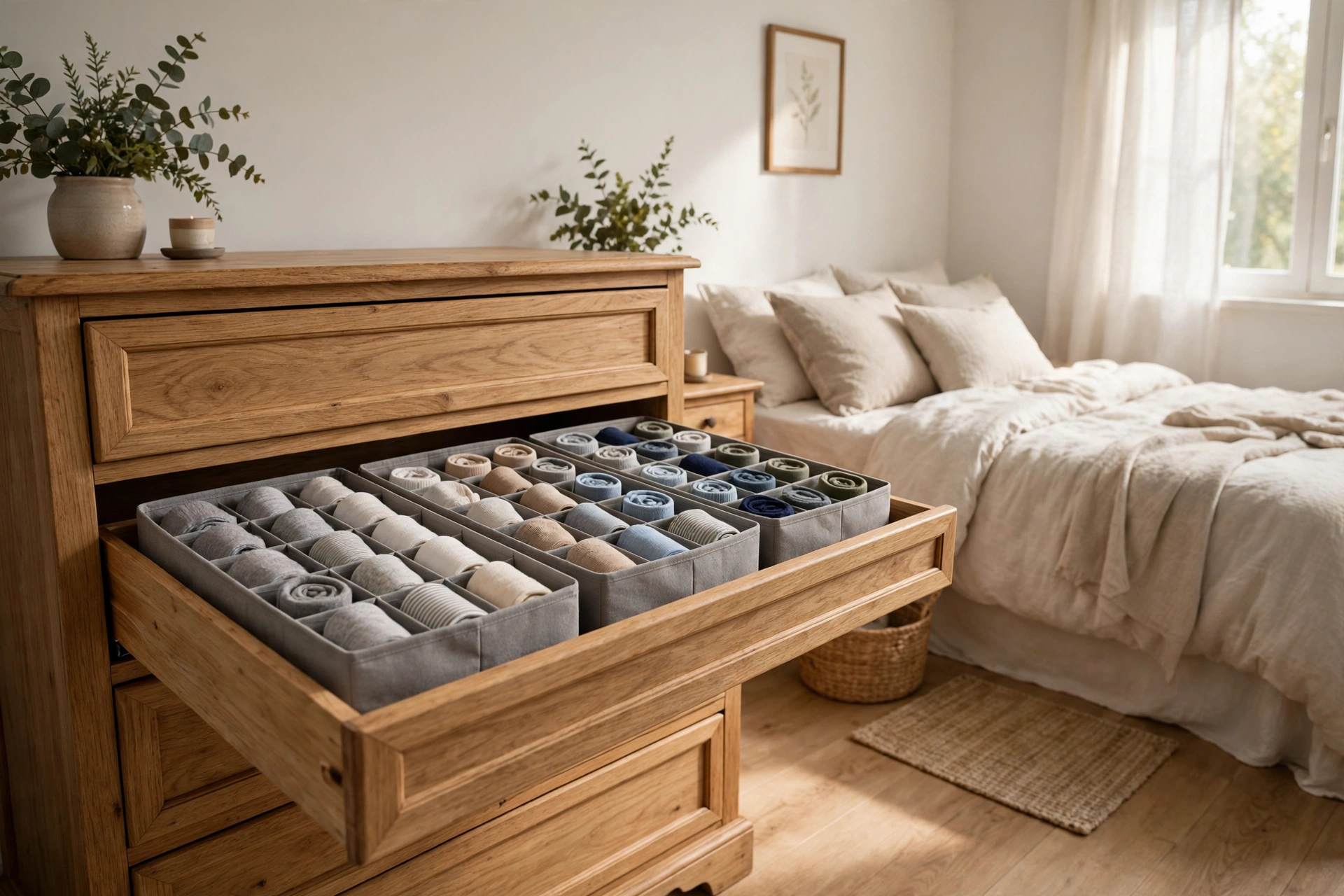
Stand in front of a stuffed drawer: the hardest part of decluttering isn't the sorting — it's deciding. Keep or let go? Every object argues for itself: it cost money, it was a gift, you might need it one day. That is exactly what good decluttering questions to ask yourself are for. They move the decision out of your feelings into a test you can answer in seconds. Here are 15 of them, grouped so any item takes a minute — plus a method for using them, and what to do with the answers.

How to Use These Decluttering Questions: The 60-Second Method
Pick one small area — a drawer, a shelf, a corner — and set a 15-minute timer. Hold each item and run the questions in order. The first clear "no" is your answer: the item goes. If an item passes every question, it stays — back to a named spot, not a pile. If you cannot decide after 60 seconds, put it in a "maybe box" (below) and move on. Stalling on one object is how 15 minutes eats a whole afternoon.
The 15 Decluttering Questions to Ask Yourself
Work in order: the first group clears the easy half of a room; the later ones handle the fighters.
Questions 1–5: Does It Earn Its Place?
1. Have I used it in the last 12 months? A full year covers every season. If the honest answer is no — and it is not a genuine emergency item — it has not earned its shelf.
2. Does it do a job right now? Not one it did three years ago, or one you hope it will do. The can opener opens cans this week; the untouched bread maker does no job.
3. Would I buy it again today, at full price? The most powerful question — it strips away sunk cost completely. If you would walk past it in a shop today, you are storing it.
4. Do I already own something that does the same job? Three spatulas, two chargers per drawer, four identical black t-shirts — duplicates are the quietest clutter. Keep the best one; let the rest go.
5. Is it easy to use, clean and put away? Anything awkward to store ends up living on the counter. If it lives in a high cupboard, you will keep avoiding it.
Questions 6–9: What Does Keeping It Cost?
6. How many do I own — and how many do I actually need? Most small kitchens need six mugs, not sixteen. Count them — the number decides for you.
7. What is it costing me to store? In a small apartment, space is rent. A box of "just in case" items is space you pay for monthly. Is the item worth its square footage?
8. Is it broken — and will I realistically fix it this month? "Someday" is not a plan. If it has sat unrepaired for a season, the repair is not happening. Deadline it — this month — or let it go.
9. Would I pack it, move it and unpack it again? Imagine moving next month: would you wrap this and carry it down the stairs — or leave it behind? Your honest answer is your decision.
Questions 10–12: Is Feeling, Not Function, Keeping It?
10. Am I keeping it out of guilt? A gift you never liked is still a gift you never liked. The kindness lives in the giving, not in the object on your shelf.
11. Would my memories survive without the object? The memory is not inside the chipped teacup — it is in you. A photograph holds it just as well. Keep the one or two that matter; photograph the rest.
12. Am I keeping it only because it was expensive? The money is already spent; keeping an unused item does not get it back. An expensive thing you never use is just expensive clutter.
Questions 13–15: What About Tomorrow?
13. Can I name the month I will use it — and what for? "Someday" is not a date; "we are hosting in December" is a plan. No month and no reason, no claim on your space.
14. Could I borrow one, or find it online? The drill you need twice a year, the manual for a gadget you no longer own — a neighbour or a quick search covers them. You need not own every tool you might touch.
15. If it disappeared today, would I replace it? The final test: if it vanished and you would shrug, you have stopped needing it. If you would buy another tomorrow, it stays — no guilt attached.
What to Do With the Tricky Categories
Some categories resist the fast questions, so give them their own rules. For sentimental items, set a small limit — one shelf, one box — keep only what fits, and photograph the rest. For paper, ask whether the information exists online or has been looked at since it arrived; most manuals and bills are a search away — our paper clutter guide covers the system. For duplicates, keep the best one and let the rest go today.
You don't have to decide what to throw away. Decide what deserves to stay — everything else has already decided for itself.

Give Every Answer a Destination
A decision without a destination becomes a new pile by the door. Before you start, set up a bag or box for each of four outcomes: Keep — it returns to a named spot in the room today. Donate — it leaves the house within the week. Sell — only if it is genuinely worth your time to list; otherwise donate it. Bin or recycle — for anything broken, incomplete or unsafe. Then keep the room light with the one-in-one-out rule: every new thing in means one thing out. If decluttering still feels overwhelming, start with our gentle 10-minute method — and use the room-by-room checklist when you are ready for the whole home.
Frequently Asked Questions
How many decluttering questions should I ask per item?
Three to five is enough. Start with the first group — used it in a year, does a job now, would I buy it again — and only move on if an item survives those. Easy items take seconds.
What if I can't decide on an item?
Use the maybe box: put the item in a dated box, out of sight, for 30 days. If you never open it, donate it unopened. The deadline decides for you.
Do these questions work for sentimental items?
Yes — but ask them last, after the easy items are gone. Start with the memory test: would a photograph hold it just as well? Keep the one or two that truly matter; let the rest go with a photo.
How often should I run through these questions?
Once a season is a good rhythm — four short sessions a year beat one exhausting weekend. Also run them before a move, after the holidays, and whenever a drawer starts overflowing.
Professional organizers ask the same kinds of questions — The Kitchn's seven questions from organizing pros and Apartment Therapy's five ruthless questions cover the same ground. The difference here is the full fifteen, grouped for speed — plus a destination step so every decision leaves the house.
Pick one drawer tonight; run it through the questions. Fifteen minutes from now it will be lighter — and you will know the next one.