If you searched for storage studio apartment, you've probably noticed something odd: half the results are storage companies trying to rent you a unit across town. This guide is the other half — 12 practical ways to fit more storage inside your studio apartment itself, without a remodel, without a big budget, and without risking your security deposit. Every idea below is budget-first and renter-friendly.
The mistake most studio dwellers make is treating the apartment as one big room and buying random organizers. Studios don't have a storage problem so much as a zone problem: sleep, live, eat, and work all happen in one box, and each zone needs its own storage right where the stuff actually lands. Fix the zones and the clutter fixes itself.

In a studio, every piece of furniture either earns its place or gets in the way. Make yours earn it.
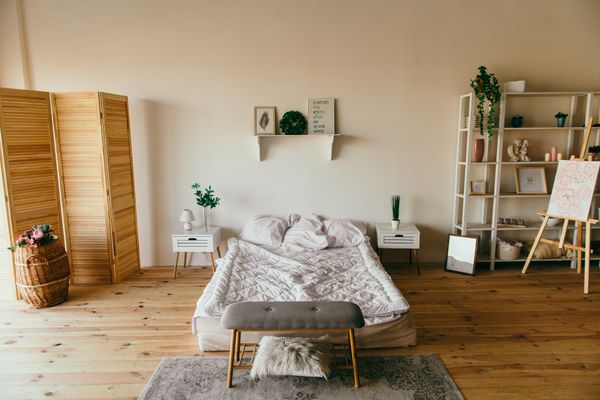
Sleep zone: studio apartment storage that disappears
1. Use the space under the bed
The single biggest unused storage spot in any studio is the footprint of your bed. Shallow rolling drawers or wheeled bins under the bed can swallow off-season clothes, spare sheets, bags, and shoes. Keep everyday items (work clothes, chargers) in a nightstand instead — under-bed storage works best for things you reach for weekly, not hourly.
2. Put a storage bench at the foot of the bed
A bench with a lift-up seat solves three small-space problems at once: a place to sit while you get dressed, a visual border between the sleep zone and living zone, and hidden storage for blankets, guest pillows, or a folded guest duvet. No assembly-drama versions are widely available secondhand for very little money.
3. Swap your headboard for storage
A headboard with shelves — or even a narrow wall-mounted ledge above the pillows — replaces a nightstand entirely. In a studio under 500 square feet, deleting one piece of furniture matters more than adding one. Store the book, the glasses, and the phone within arm's reach, and let the floor breathe.
Live zone: storage that doubles as furniture
4. Divide the room with a storage bookcase
An open-back bookcase placed perpendicular to the wall is the classic studio trick: it creates a "bedroom" on one side and a "living room" on the other while adding shelves you desperately need. Open backs let light through so the room still feels airy. Style one side for display, and use lidded boxes on the back-facing shelves for the ugly stuff.
5. Make the coffee table work harder
A lift-top or drawer coffee table hides remotes, chargers, notebooks, and the board games that otherwise live in a permanent pile. The lift-top version is a bonus for studios with no room for a dining table — it becomes your dinner surface and your laptop desk.
6. Claim the 6 inches behind the sofa
That dead strip of wall behind the couch is a natural bookshelf: slim rolling carts or a narrow console table fits without anyone noticing. Use it for books, media gear, or a charging drawer so cables never snake across the floor. Measure first — most sofas sit 4 to 6 inches off the wall, and that's all you need.
Eat zone: kitchen storage beyond the cabinets
7. Sit on a dining bench with drawers
If your eating corner is a small table, trade the chairs on one side for a storage bench. It seats more people in less space (no chair legs to arrange) and the drawers underneath are perfect for placemats, napkins, spare dish towels, and the serving pieces you only touch on holidays.
8. Roll in a kitchen cart
A slim rolling cart is a pantry on wheels: park it in the 8-inch gap between the fridge and the wall, or beside the counter. Load the top tier with daily cooking supplies and the lower tiers with backstock. When you cook, roll it to the stove; when you host, roll it away. For more renter-friendly storage ideas, this is one of the cheapest wins in the whole list.
Work and entry zone: storage in the hardest corners
9. Hang a fold-down desk
A wall-mounted drop-leaf desk gives you a real work surface that folds flat to a 4-inch-deep shelf when you're done. Pair it with a lidded bin for work supplies (laptop, notebooks, chargers) that lives on a shelf nearby. The "office" appears at 9 a.m. and vanishes at 6 p.m. — which matters when your office is also your living room.
10. Build an entry wall, not an entry pile
In a studio, there's rarely a foyer — bags, shoes, and keys land in the first open spot. Fix it with one dedicated entry wall: a row of hooks for bags and jackets, a slim tilt-out or wall-mounted shoe cabinet, and a small tray or shelf for keys and mail. Everything gets a home the moment you walk in.
11. Go vertical in every single zone
Walls are free square footage, and studios have plenty of them. Tall narrow bookcases, floating shelves above the desk, pegboard in the kitchen corner — each adds cubic feet without taking a single inch of floor. Our full list of vertical wall storage ideas breaks this down room by room. One rule: keep the heaviest and least-used things up high, and daily items at arm level.
12. Create a wardrobe where no closet exists
Many studios have one tiny closet or none at all. A freestanding wardrobe — or a sturdy garment rack plus a curtain — placed right by the entry doubles as a coat closet and a room divider. Put seasonal and rarely-worn items up top, daily wear at the middle, and shoes in boxes along the bottom.
Try this today: the 5-minute studio reset. Set a timer. Return 5 things to their zones: 1) shoes to the entry wall, 2) the mug to the kitchen, 3) clothes to the wardrobe or hamper, 4) mail to the entry tray, 5) one surface wiped clear. Do it every evening and the apartment resets itself. And if you're drowning in stuff first, start by decluttering what you don't need — storage only works when there's less to store.
Want more inspiration from real small homes? Apartment Therapy's small-space storage ideas and this studio apartment decorating guide show how renters make these exact tricks work in apartments as small as 300 square feet.
FAQs
How do you add storage to a studio apartment with no closet?
Use freestanding wardrobes or garment racks for clothes, under-bed drawers for off-season items, and one dedicated entry wall with hooks and a slim shoe cabinet. Most "no closet" studios just need the clothes system rebuilt from scratch.
What furniture gives the most storage in a studio?
Beds with drawers or lift-up bases, storage benches, lift-top coffee tables, and bookcases used as room dividers. Each one stores things and defines a zone, so they pay for their floor space twice.
How do you keep a studio apartment from looking cluttered?
Mix open and closed storage: display a few nice things, hide everything else in lidded boxes, drawers, and closed cabinets. One "everything has a home" reset each evening does more than any organizer.
Is it better to declutter first or buy storage first?
Declutter first, always. Storage bought for stuff you don't actually need just moves the clutter into nicer boxes. Purge each zone, then buy only what the remaining items require.