Sewing room organization for small spaces is less about buying more storage and more about giving every tool a job and a home. If your sewing machine lives on the dining table, your fabric stash is colonizing the closet, and your scissors vanish in the middle of every single project, this guide is for you. Below you'll find a simple 7-step zone method, 12 budget-friendly ideas that work in a corner, a closet, or a spare room — and nearly all of them are renter-safe, with no drilling and no permanent changes. Most of the setup costs under $100 in total, and you can do it in one weekend.

Sewing Room Organization for Small Spaces Starts With Zones
Before you buy a single bin, divide your space into three zones: sew, cut and press, and store. Everything you own belongs in one of them, and nothing lives on your work surface unless it is used in that zone. The zone method works in a 10-by-10 spare room, a walk-in closet, or a corner of the bedroom — the zones just get smaller, not fewer. Set up in this order:
- Measure first. Tape out your table, machine, and cutting area on the floor before moving anything. A 24-inch-deep table is enough for most machines.
- Declutter by category. Sort fabric, patterns, notions, tools, and unfinished projects into separate piles, then keep, donate, or toss from each pile. Category by category is faster than tidying one corner at a time.
- Put the machine where the light is. Natural light near a window cuts eye strain and shows true thread and fabric colors. If there is no window, add a daylight LED task lamp.
- Claim your cutting surface. You need more room to cut than to sew. A folding table, a cleared desk, or a cutting mat on a counter all count — just make it a permanent spot, not a pop-up.
- Give pressing a permanent home. A small tabletop ironing board or a TV-tray pressing station beats dragging the big board out every time.
- Store fabric vertically. Folded fabric filed upright in a bin or on a shelf lets you pull one piece without toppling a stack.
- Set a one-project-out rule. Only the project you are sewing on stays out. Everything else lives in its own labeled bag or bin.
12 Sewing Room Organization Ideas for Small Spaces
Each idea below costs little, needs no drilling, and works in a corner, a closet, or a whole spare room.
1. Hang a pegboard above the machine
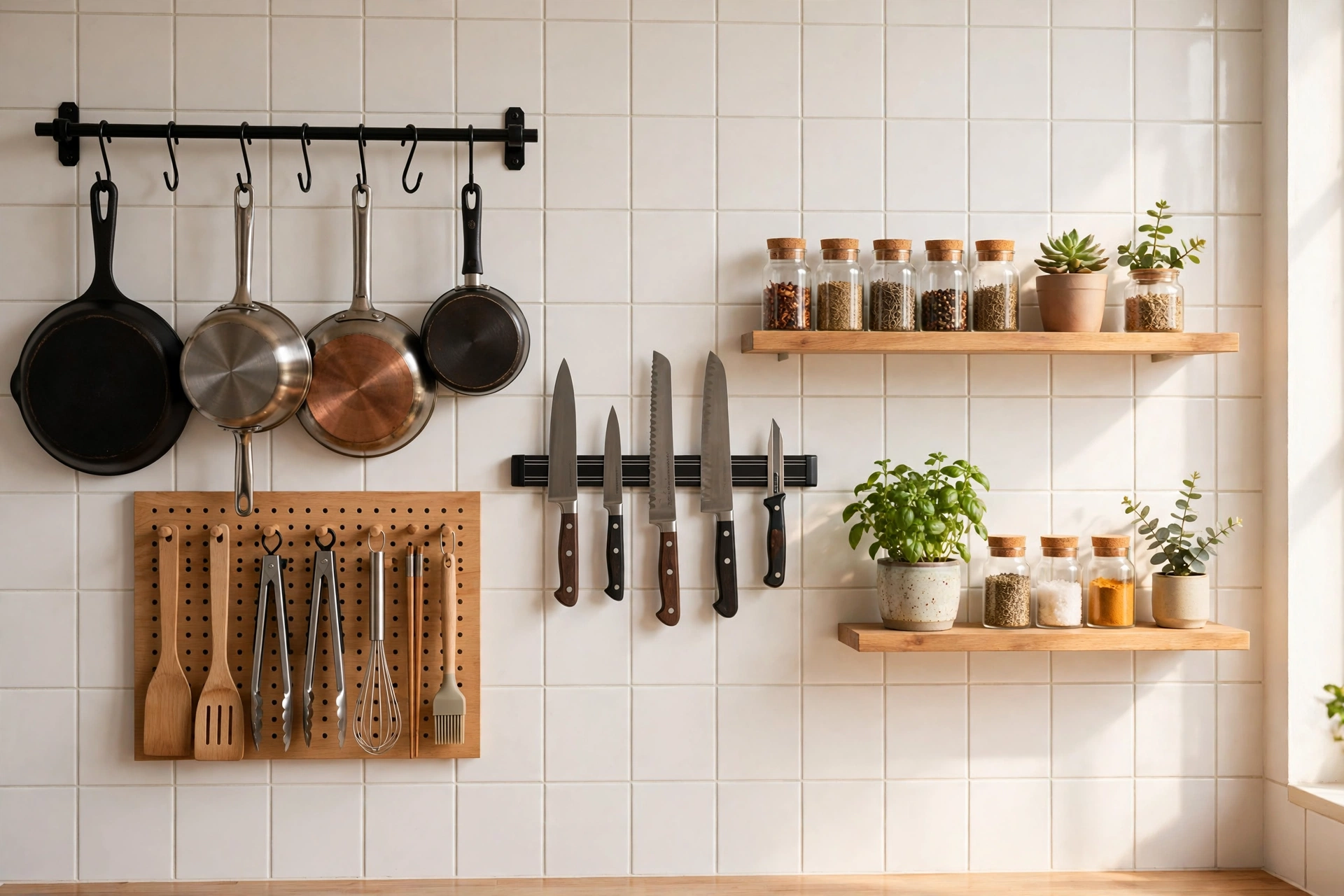
A small pegboard holds scissors, rulers, rotary cutters, and measuring tape within arm's reach — and it frees your whole tabletop. Use removable hooks and adhesive strips if you rent, and keep only the tools you use every session on it. The same "go up, not out" thinking powers our vertical wall storage ideas for the rest of a small home.
2. Mount a wall thread rack
Thread spools stacked in a drawer tangle and hide. A wall-mounted rack sorts them by color so you can see every shade at a glance. A 30-spool rack costs about $10–$20 and mounts with two small screws or heavy-duty adhesive strips.

3. Roll a cart to your chair
A three-tier rolling cart is the workhorse of small sewing rooms: thread and notions on top, tools in the middle, the current project at the bottom. Roll it beside you while you sew, then park it in a closet gap when guests come over.
4. Bag every project separately
Each unfinished project gets its own clear zip bag or basket: pattern, fabric, thread, and special notions together. When you want to sew it, you grab one bag — no hunting through a pile.
5. Fold fabric like files
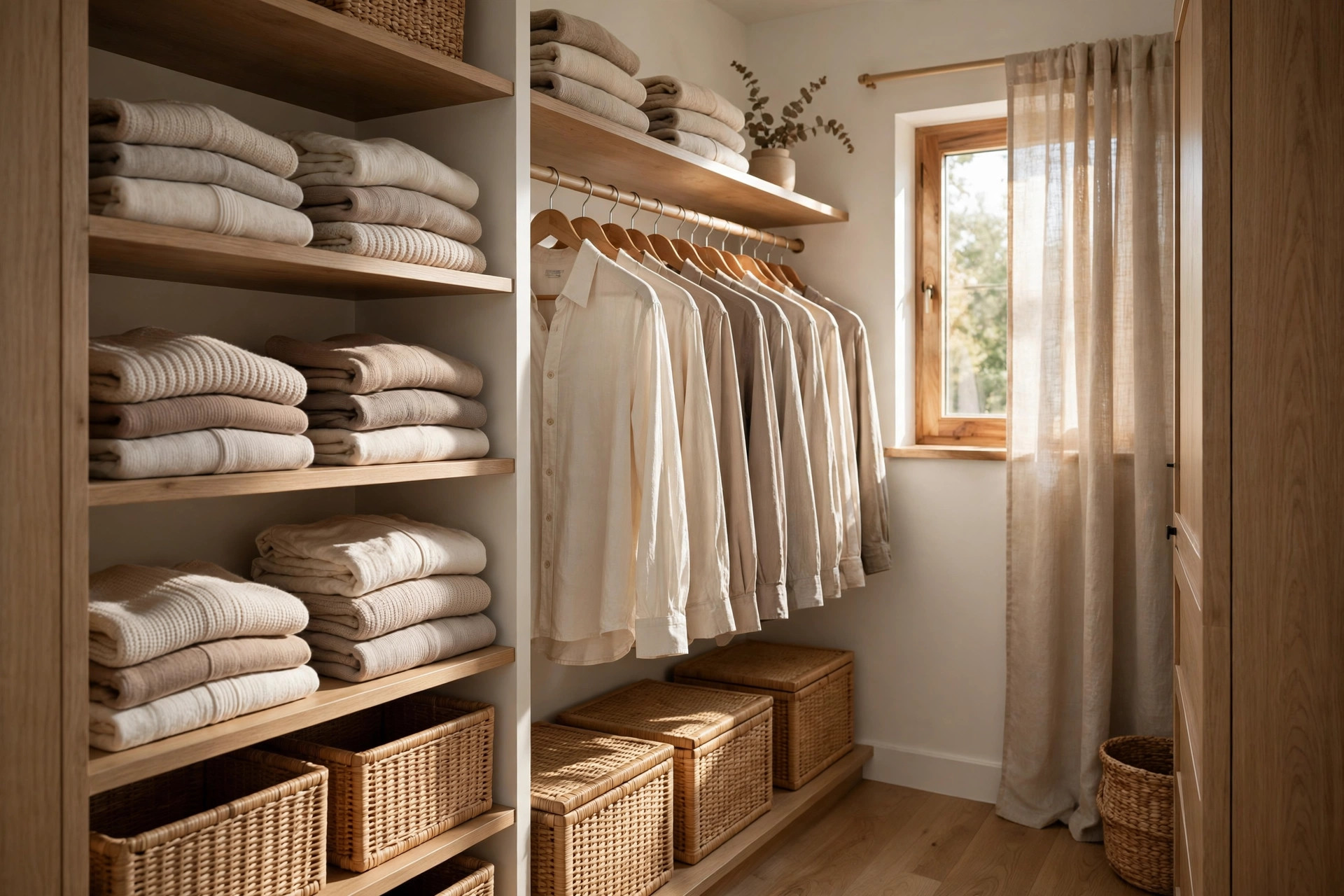
Fold fabric into uniform rectangles and file them upright in a bin, like books on a shelf. You can see every print, pull one without disturbing the rest, and a full bin is a visible signal to stop buying fabric until you sew some down.
6. Use an over-the-door organizer for notions
Clear-pocket shoe organizers hung on the back of a door hold ribbons, zippers, elastic, interfacing, and bias tape — all visible, all off your surfaces. At about $10–$15, it is the cheapest storage in this whole list.
7. Fold down your cutting table
A wall-mounted fold-down table gives you a full cutting surface when you need it and your floor back when you don't. If even that is too much, a large cutting mat on the bed or dining table works — just store the mat flat under the bed afterward.
8. Divide drawers for tiny notions
Buttons, bobbins, needles, and snaps vanish in a junk drawer. Small drawer dividers or repurposed ice-cube trays keep each type separate — and one divider set costs less than a single lost afternoon hunting for a bobbin.
9. Build a TV-tray pressing station
A folding TV tray topped with a cotton-covered pressing pad is a full ironing station that collapses flat. Keep the iron on a heat-proof rest beside it, and pressing stops being the chore that makes you avoid sewing.
10. Label every bin — even the pretty ones
Matching baskets look tidy for a week; labels keep them tidy for a year. A label maker, or masking tape and a marker, is enough. Label the front and the top so bins are findable on a high shelf too.
11. Turn the closet into a fabric library
If your sewing space is a closet, treat it like a library: fabric filed by color on one shelf, patterns in magazine holders on another, notions in labeled bins below. Borrow the fold-away tricks from our cloffice ideas — a closet workspace works the same way whether it holds a laptop or a sewing machine.
12. Reset for 10 minutes after every session
The system only works if it gets reset. After each session, spend 10 minutes: tools back on the pegboard, scraps in the scrap bin, the project bag zipped, and the table cleared. A tidy room is what makes you sit down to sew tomorrow.

Fabric Storage That Doesn't Eat Your Room
Fabric is the one supply that grows on its own. Set a hard limit: one shelf, one bin, or one closet rod — your stash lives inside that boundary, and nothing new comes in until something is sewn, gifted, or donated. Fold larger cuts and roll knits and slippery fabrics so they don't slide. Keep a scrap bin with a lid; when it is full, sort it once — keep the pieces big enough to use, pass the rest on. For more on keeping craft supplies under control, see our craft supplies storage ideas and AllFreeSewing's guide to organizing a small sewing room.
A small sewing room doesn't need more storage. It needs fewer decisions about where things live.
A Renter-Friendly Budget: What This Setup Costs
You don't need to buy everything at once. Start with the pegboard and the project bags, then add pieces as you sew:
- Pegboard + hooks: $15–$25
- Wall thread rack: $10–$20
- Three-tier rolling cart: $25–$40
- Over-the-door organizer: $10–$15
- Clear project bags + bins: $10–$15
- Labels + drawer dividers: $5–$10
All in, a complete setup runs about $75–$125 — and every piece moves with you when you move. Apartment Therapy notes that sewing rooms were once a standard feature of American homes, built as small service rooms off bedrooms — so a tiny dedicated corner is truer to the tradition than a sprawling studio. Read their piece on why sewing rooms are disappearing from American homes.
Quick tip: Try the one-in, one-out rule for fabric — every new yard in means one yard out, sewn, gifted, or donated. It is the only rule that keeps a small stash small.
Sewing Room Organization FAQs
How do I organize a sewing room in a very small apartment?
Start with zones, not furniture: one corner for sewing, one fold-down surface for cutting, and one closet or cart for storage. A rolling cart and an over-the-door organizer can hold a full setup in under 10 square feet.
What is the best way to store fabric in a small space?
Fold fabric into uniform pieces and file them upright in bins or on shelves, sorted by color or project. Cap the stash at one shelf or bin, and let nothing new in until something is used up.
How can I set up a sewing area without a dedicated room?
Use a fold-down table or a cleared desk as your machine station, keep tools in a caddy or rolling cart, and store everything else in labeled project bags in a closet. Pack-away systems work — the key is that setup takes under five minutes.
How do I keep a small sewing room tidy long-term?
Keep only one project out at a time, do a 10-minute reset after every session, and follow one-in, one-out for fabric and patterns. Small habits beat big reorganizations.