A jammed drawer where the potato masher tangles with the whisk, a spatula that slides behind the counter every time you stir — kitchen utensil storage in a small kitchen is usually one overflowing drawer and a lot of frustration. If your only utensil drawer is already spoken for, the answer isn't a bigger kitchen: it's moving utensils out of the drawer entirely. Every idea below is budget-friendly, renter-safe, and needs zero drilling.
Countertop Utensil Storage That Doesn't Eat Your Prep Space
Countertop storage works when it stays compact — a utensil zone should take up one corner, not half the counter. Keep only the tools you grab while cooking (spatula, wooden spoon, tongs, ladle) and give everything else a new home below.
1. One tall crock for daily drivers
A single tall, heavy crock beside the stove holds your 5–6 everyday utensils upright and grabbable with wet hands. Choose a crock wide enough that tools don't stack on each other, and heavy enough that it won't tip when you pull one out. This frees your drawer for the less-used gadgets — a trick that pairs well with small kitchen counter organization systems.
2. Split tools into two smaller crocks by zone
If one crock becomes a tangled mess, split the tools: cooking utensils (spatulas, spoons, tongs) near the stove, and prep tools (whisks, peelers, measuring cups) near your cutting board. Two small crocks take up barely more room than one big one, and you stop digging past the ladle to reach the whisk.
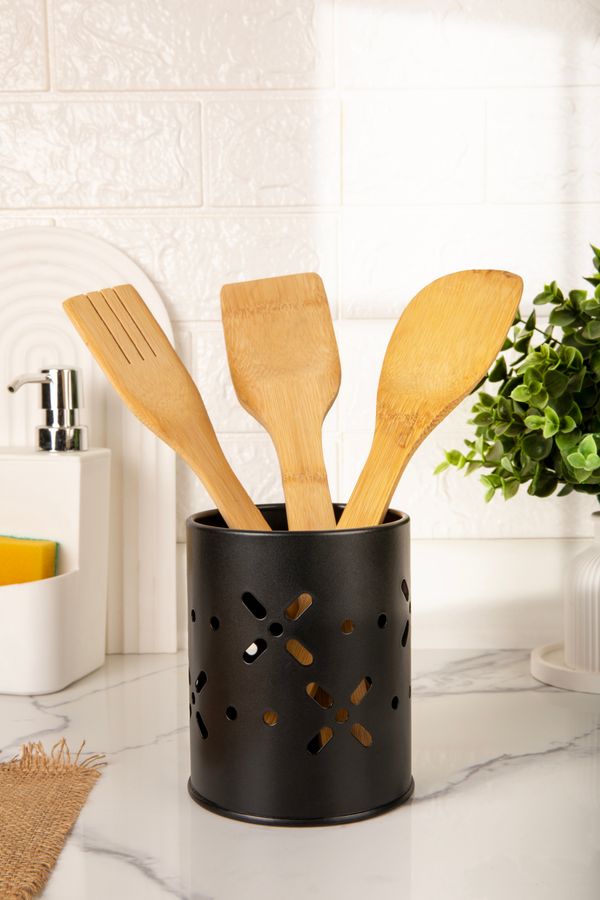
3. Use a divided caddy instead of an open crock
An open crock lets long tools flop together. A divided caddy (the kind with 3–4 sections) keeps spatulas, spoons, and tongs separated and visible. It's the same "give everything its own lane" logic behind organizing a junk drawer — just moved to the counter.
4. Park a spoon rest where you cook
The in-use spoon or spatula needs a landing spot between stirs, or it ends up on the counter leaving a sauce trail. A simple ceramic spoon rest by the stove catches drips and keeps one tool out of the crock while you cook. One less utensil in circulation means less clutter overall.
Hang It Up: Wall & Cabinet-Door Utensil Storage
Walls and cabinet doors are free storage in a small kitchen — and utensils with a hole or loop in the handle are made for hanging. No drill, no landlord conflict, and tools dry faster hanging than they do stacked in a drawer.
5. A short rail with S-hooks near the stove
A self-adhesive or tension-mounted rail on the wall or backsplash beside your stove, fitted with S-hooks, holds ladles, spatulas, and whisks in plain sight. Everything you hang is one you don't have to dig for — and hanging keeps awkward-shaped tools from snagging each other the way they do in drawers.
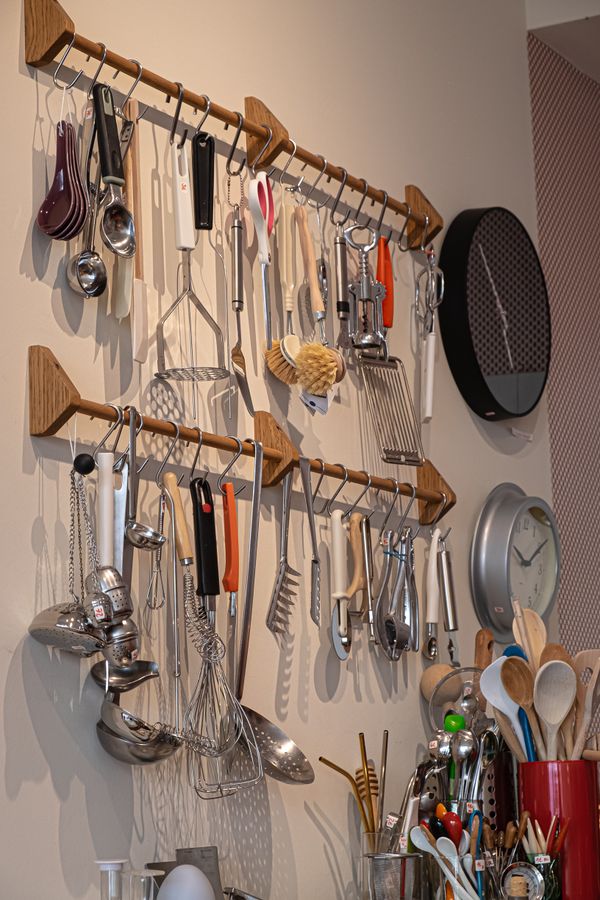
6. Adhesive hooks inside cabinet doors
Sturdy self-adhesive hooks stuck to the inside of a cabinet door hold measuring cups, tongs, and oven mitts completely out of sight. It's the hidden version of hanging storage — nothing shows, nothing clutters, and the hooks peel off cleanly when you move. This is one of the most versatile moves in over-the-door storage, applied at cabinet scale.
7. A magnetic strip for metal tools
A magnetic knife strip isn't just for knives — small metal utensils like measuring spoons, tongs, and even a garlic press stick to it happily. Mount one on the inside of a cabinet door or on an unused stretch of wall. Just check your utensils are actually magnetic before buying (some stainless steel isn't).
8. Over-the-cabinet-door hook for bulky tools
An over-the-door hook on a cabinet or pantry door handles the bulky tools that defy drawers and crocks — the potato masher, the large strainer, the foldable steamer basket. They hang flat and out of the way, and the hook lifts off in seconds when you rearrange.
Make the Drawer You Have Work Harder
If you do have one utensil drawer, a few cheap adjustments double its capacity. And if the drawer is missing entirely, these same rules help you assign the remaining storage sensibly.
9. Add an expandable in-drawer organizer
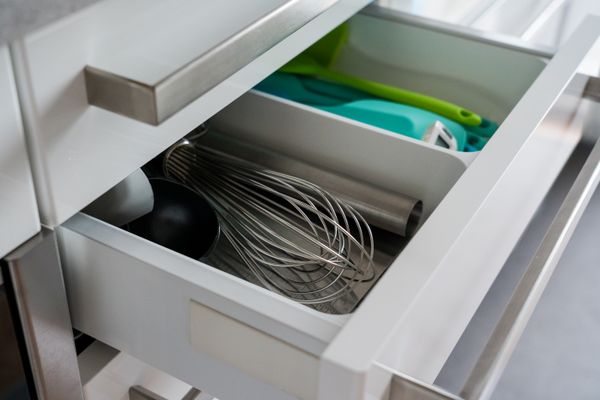
A narrow drawer feels useless for utensils until you add an expandable tray with deep compartments. Long tools lie in the long slots; small gadgets go in the square ones. The tray stops the "everything slides to the back" problem that makes small drawers feel full when they're half-empty.
10. Store long tools diagonally or vertically
Diagonal placement buys you inches in a shallow drawer — angle spatulas and ladles corner-to-corner instead of fighting the short side. Better still, if your drawer is deep, use a bamboo box inside it to stand tools upright like a mini countertop crock, filing style. The cabinet organization playbook uses the same vertical-filing logic for baking sheets and cutting boards.
11. Move knives out of the utensil drawer
A knife block or full knife set devours drawer space. Switch daily knives to a magnetic wall strip or an in-drawer knife dock (a slim insert that holds blades safely in one slot), and you instantly win back a third of your drawer for the rest of the utensils.
12. One utensil per job — declutter the collection
The cheapest storage upgrade is owning fewer utensils. Keep one good spatula, one wooden spoon, one pair of tongs, one ladle, and one whisk — and box up the duplicates. Most utensil-drawer chaos isn't a storage problem, it's a volume problem. Fewer tools fit anywhere: crock, rail, hook, or drawer.
Budget tip: The highest-impact combo is a self-adhesive wall rail with 5 S-hooks plus one divided caddy — typically under $15 total. The rail handles the long, awkward tools; the caddy handles daily drivers; and a 10-minute declutter handles the rest. No drilling, no landlord permission needed.
"Utensils don't need a drawer — they need a home. A hook, a rail, or a crock beats a jammed drawer every time." — The Small Nest
For more tested small-space picks, Apartment Therapy's guide to kitchen utensil storage solutions for small spaces rounds up renter-friendly holders, tension organizers, and under-cabinet hooks. Their genius small-space kitchen tools piece also shows how compact, flattening, and nesting versions of bulky tools free up real room.
Frequently Asked Questions
Where should I store kitchen utensils if I have no drawer space?
Use a countertop crock for daily tools, a self-adhesive wall rail with S-hooks for long utensils, and adhesive hooks inside cabinet doors for measuring cups and tongs. All three are renter-safe and need no drilling.
How do I keep cooking utensils organized on a small counter?
Limit countertop utensils to the 5–6 tools you use every day, store them upright in one divided caddy near the stove, and give everything else a hanging or cabinet home. One contained zone keeps the counter from feeling cluttered.
What's the best renter-friendly way to hang kitchen utensils?
Self-adhesive rails and hooks, over-the-cabinet-door hooks, and tension-mounted bars all hold utensils without drilling. Choose adhesive rated for at least 3 lb per hook so damp, heavy tools stay put.
How many kitchen utensils do I actually need?
One of each daily tool is enough for most home cooks: a spatula, wooden spoon, tongs, ladle, whisk, and peeler. Box up duplicates — most utensil clutter comes from owning three of everything, not from bad storage.
You don't need more storage — you need a home for every utensil that isn't a jammed drawer. Hang the long tools, crock the daily ones, and let the drawer (if you have one) hold only what you use weekly. Pick one idea tonight and tomorrow's cooking will feel calmer.