
If you have ever opened a kitchen cabinet only to be hit by an avalanche of lids, bowls, and mystery containers, you are not alone. These small kitchen cabinet organization ideas are made for tiny kitchens, tight budgets, and rentals you cannot remodel. No power tools, no landlord arguments — just clever renter-friendly tricks that can double how much your existing cabinets hold.
Before You Start: The 5-Minute Cabinet Reset
Organization products never fix overstuffed cabinets. Pull everything out of one cabinet, wipe the shelf, and ask of each item: do I use it weekly? Is it broken? Does it earn its space? Duplicates — three spatulas, five mugs for two people — are why your cabinets feel small. Box the extras for donation. (Our room-by-room decluttering checklist is a great companion if you are on a full declutter run.)
14 Small Kitchen Cabinet Organization Ideas for Tiny Kitchens
1. Add shelf risers to double every level
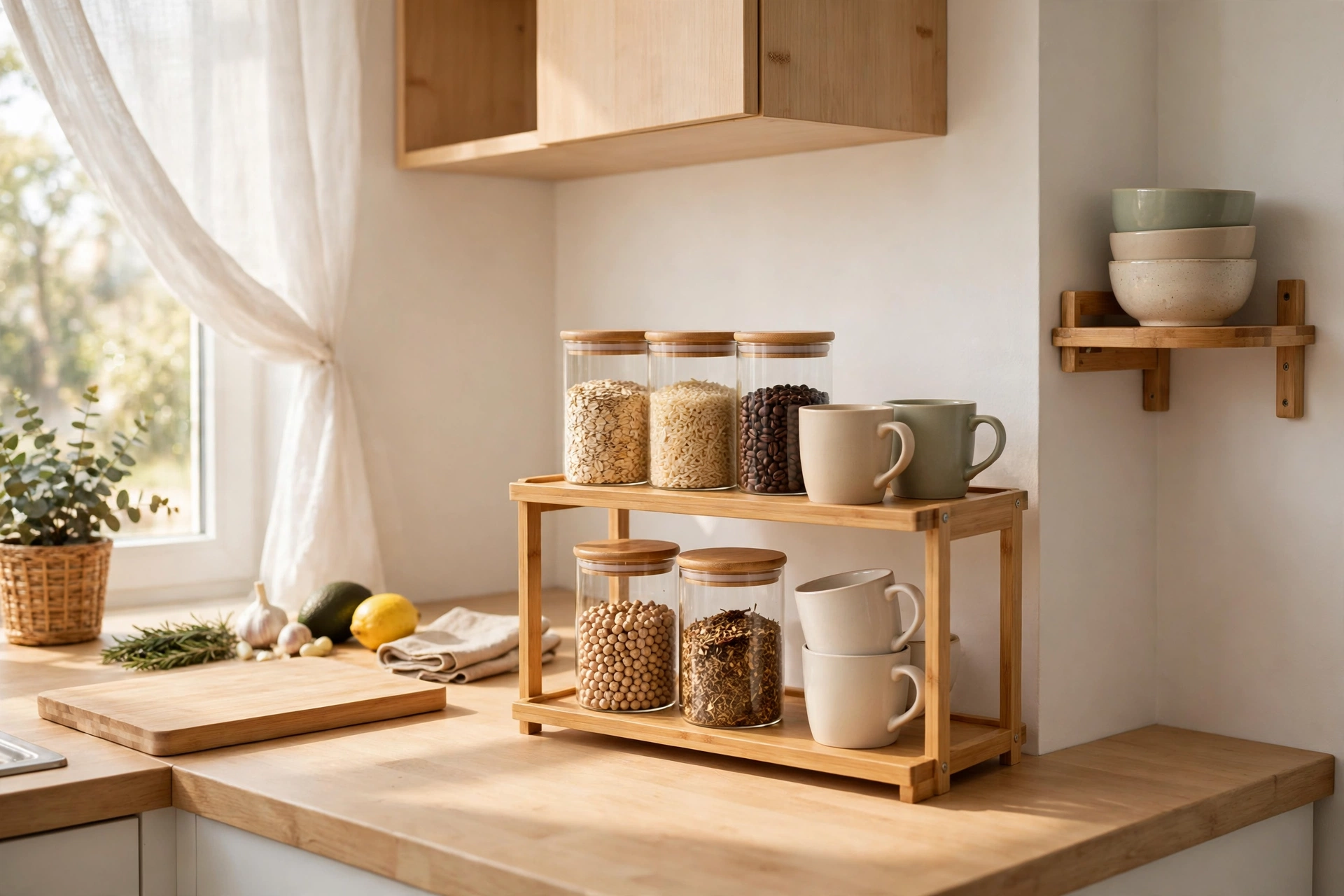
Most cabinets waste 8–12 inches of empty air above your dishes. A simple shelf riser creates a second level — bowls below, plates above. Risers cost just a few dollars at dollar stores, need no installation, and lift straight out when you move. This single change adds more usable storage than almost any other trick here.
2. Use under-shelf baskets for dead air
Wire baskets that hook under a shelf claim the empty space above mugs or canned goods. They are perfect for light items — tea boxes, seasoning packets, snack bars — and slide on in seconds without screws. Pair them with risers and one shelf can hold three distinct layers of stuff.
3. File baking sheets and cutting boards vertically
Stop stacking sheet pans and boards flat, where you must lift the whole pile to reach the bottom one. Stand them on edge like files, using a cheap plate rack or even a tension rod wedged inside the cabinet as dividers. Everything becomes visible and grabbable in one motion.
4. Mount hooks or a rail on the inside of cabinet doors
Inside a cabinet door is free real estate. Stick-on hooks hold measuring cups and spoons; a slim adhesive rail holds pot lids or wraps. Nothing gets drilled, nothing gets damaged, and you gain storage exactly where the clutter usually lived.
5. Turn a lazy Susan loose in deep cabinets
Deep corner cabinets are where cans go to be forgotten. A small turntable (lazy Susan) lets you spin the whole group forward, so the back of the cabinet is never a black hole again. One per deep cabinet is enough, and they work beautifully for oils, vinegars, and spice jars.
6. Decant dry goods into matching square containers
Flour, rice, pasta, and snacks come in awkward half-used bags. Moving them into uniform square containers kills dead gaps, everything stacks, and you can see at a glance what is running low. Keep just what you actually buy — a tiny kitchen needs no backup pantry. Our tiny-kitchen pantry ideas cover the same logic in more depth.
7. Stack pots and pans with lid storage on top
The classic clatter-stack wastes height and turns every lid into a treasure hunt. Nest pans by size, then store lids on edge in a cheap lid rack or repurposed dish rack. If your cabinet is shallow, hang your two most-used pans outside it and reclaim the shelf.
8. Zone each cabinet by cooking task
Assign cabinets by task instead of item type: a cooking zone near the stove (oils, spices, utensils), a prep zone near the sink (bowls, boards, strainers), and a dish zone near the drying rack. You will stop crossing the kitchen mid-recipe.
9. Use clear bins as pull-out drawers
Shallow cabinets become deep dark caves you cannot reach into. Slip a low clear bin onto each shelf and it works like a pull-out drawer: grab the bin, slide it forward, everything is visible. Label the front and the whole cabinet reads as calm instead of chaotic.
10. Store heavy items low, daily items at eye level
Respect the "golden zone" between your hips and shoulders for things you touch every day: coffee, breakfast dishes, spices. Heavy appliances and holiday dishes go low or high. This is not just comfort — it stops the daily re-stacking shuffle that undoes all your organizing.
11. Hang mugs under the cabinet or on hooks
Mugs are space hogs. A set of adhesive hooks under an upper cabinet, or hooks on the underside of a shelf inside a cabinet, frees an entire shelf level. Two people do not need twelve mugs in prime real estate — keep two each and relocate the rest.
12. Add a tension rod for vertical spray-bottle parking
Tension rods are renter gold: no drilling, instant dividers. Wedge one horizontally in a cabinet to stop plate stacks from sliding, or vertically to separate cutting boards. Under the sink, a horizontal rod creates a mini "garage" to park spray bottles upright. (More under-sink tricks live in our under-sink organization guide.)
13. Use the cabinet above the fridge for the rarely used
That awkward cabinet above the refrigerator is terrible for daily items and perfect for once-a-season ones: the holiday platter, the monthly blender, the big serving bowl. Corral them in one labeled bin so nothing slides back when you open the door.
14. Keep one "in-and-out" shelf for the weekly reset
Even organized kitchens drift. Reserve one easy-reach shelf as a landing pad — today's groceries, the snack bin, the thing you will put away "in a minute." Every Sunday, spend five minutes returning the landing pad to empty. This tiny ritual protects all the other thirteen ideas.
Renter-Friendly Rules for Every Idea
Every trick above passes the rental test: no drilling, no permanent changes. Stick to weight-rated adhesive hooks, removable tension rods, and freestanding organizers that lift out cleanly. If you are weighing which upgrades are worth buying, the budget guide at Apartment Therapy's small kitchen ideas is full of renter-safe inspiration, and Living in a Shoebox shows how far vertical storage can go in genuinely tiny kitchens. And if your counters are the next battleground, see our small kitchen counter organization ideas.
"A small kitchen is not a storage problem. It is an organization problem wearing a storage costume."
FAQs
How do I organize small kitchen cabinets with no pantry?
Treat your cabinets as zones: decant dry goods into stackable square containers, use shelf risers to double each level, and dedicate the above-fridge cabinet to overflow. Zone-based cabinets can easily replace a pantry in a tiny kitchen.
What is the best way to organize deep kitchen cabinets?
Make deep cabinets pull-out friendly: place low clear bins on each shelf so you can slide the contents forward, and add a lazy Susan in corners so nothing hides at the back. Never store small loose items deep inside without a container.
How can I add storage to kitchen cabinets without drilling?
Use adhesive hooks, under-shelf wire baskets, shelf risers, tension rods, and freestanding turntables. All of these add real storage without a single screw, which makes them ideal for renters.
How often should I reorganize my kitchen cabinets?
Do a five-minute tidy weekly and a deeper reset every three to four months — pull a cabinet out, toss expired items, and check that everything still earns its space. Seasonal resets keep clutter from creeping back in.
A tiny kitchen does not need more cabinets — just cabinets that work twice as hard. Pick three ideas from this list, spend one afternoon, and your cabinets will feel twice as big by dinner.